The first thing that every business owner needs to know. In this handy guide, we at McGinty Demack accountants have answered just that. Below is a simple, straight to the point guide which all of you operating as sole traders and partnerships can use, to ensure that you are doing everything that you can to keep your tax bills low.
Are you getting it right. Are you claiming for everything ?
Costs you can claim as allowable expenses
These include:
office costs, for example stationery or phone bills
travel costs, for example fuel, parking, train or bus fares
Selling a Residential Property and reporting the Sale to HMRC
In the Budget the Chancellor extended the period for Zero stamp duty on property purchases up to £500,000 until the 30th June 2021. After this date the zero threshold will reduce to £250,000 up to the 30th September 2021 and then drop down to £125,000.
This is great news for buyers and a further boost to the housing market.
Please remember that if you are buying a second property then the additional stamp duty still applies at a 3% surcharge.
Property bought in a company however will benefit from the new rates up to the 30th June 2021 provided the property is under the £500,000 limit.
Ask us for advice on this aspect if you are looking to buy a residential property.
What if you are a seller?
As a seller this should increase your chances of selling your property but beware if the property is not your main residence and you have potential capital gains tax to pay you must report the sale within 30 days to HMRC.
This new legislation came in for disposals after 6th April 2020.
When do I have Capital Gains Tax To Pay?
If the property is your main home, then you will not have to pay capital gains tax as it qualifies for Principle Property Relief.
If however you own another residential property perhaps you have bought a holiday home that just the family uses, you have bought a property for your children to live in whilst at university or you have residential property that you let out, then the new legislation may apply to you.
Capital Gains Tax is calculated based on the price you sell the property for after allowing for the price you paid for the property less other deductible costs.
Will It Apply to Me?
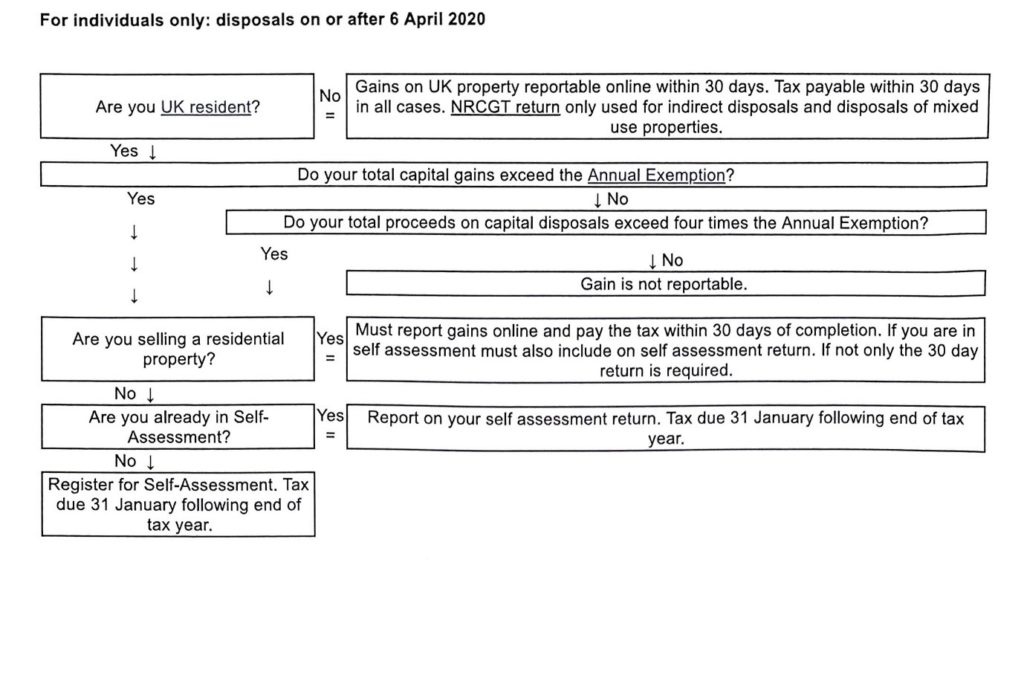
The flow chart below is a simple guide as to whether you will have to report the sale to HMRC.
What to Do to report the Gain
Step One
Work out if you have any capital gains tax to pay on the property. To do this you will need the following information:
calculations for each capital gain or loss you report
details of how much you bought and sold the asset for
the dates when you took ownership and disposed of the asset
any other relevant details, such as the costs of disposing of the asset and any tax reliefs you’re entitled to
If you have a gain then move on to :
Step Two
Create a Capital gains Tax Gateway account with HMRC if you do not already have one
This must be done within 30 days of the property disposal date.
Step Four
HMRC will send you a letter advising you what you owe and giving you a reference number and details of how to pay
Do I have to do anything else?
Yes, if you complete a self-assessment tax return the gain details should also be recorded on to this return as part of your normal self-assessment completion.
Don’t wait until the deadlines for your self-assessment return as you may then face interest on the capital gains tax due.
This is a complicated area of tax law and if you need any advice on this we can assist and complete the calculations and the returns on your behalf.
We can provide a quote for this work to be done for you – Obtain Quote Now
The Chancellor Rishi Sunak delivered his second Budget earlier this afternoon, setting out his three-point plan to protect jobs and livelihoods, fix the public finances and build the future economy. With the largest debt since the World Wars how he plans the country’s finances is key to the countries recovery.
Tax thresholds and allowances have been frozen, he however delayed any major tax changes probably to see how the economy and business responds once COVID restrictions start to be lifted.
The key tax measure announcements include:
Personal tax thresholds are frozen until 2022. Increases are promised in 2022, with a further freeze until 2026.
From 2023 the Corporation Tax rate will increase to 25%. The current rate of 19% will continue to apply to small businesses with profits of £50k or less. A tapered rate will apply to companies with profits of between £50k and £250k.
Companies will be able to carry back losses for three years, to secure repayment of tax paid in prior years.
A super-deduction (Capital Allowance) for business investment at 130% of costs, for companies, will apply for two years.
The nil rate band for Inheritance Tax, the Lifetime Limit and Annual Allowances for pensions, and the VAT registration threshold are all frozen.
The Coronavirus Job Retention Scheme (furlough scheme) is extended to the end of September, with a 10% contribution from employers for July and August, and 20% for September. Employees will continue to receive 80% of salary for unworked hours.
Self-Employed Support Scheme extended, with grants 4 and 5. The newly self-employed who have submitted 2019-20 tax returns can apply. An 80% grant continues to apply where profits are reduced by 30% or more. A 30% grant will apply where profits are reduced by less than 30%.
Stamp Duty Land Tax (SDLT): the £500k nil rate band is extended to 30 June. A £250k nil rate band will then apply until 30 September.
The 5% rate of VAT for the tourism and hospitality sectors is extended to 30 June. An interim rate of 12.5% will then apply until April 2022.
New restart grants of £6k for non-essential retail businesses and £18k for hospitality businesses will be available from April.
Business rates holiday for the retail, hospitality and tourism sectors is extended to 30 June. A two-thirds discount will then apply for the rest of 2021/22.
Investment in HMRC to tackle COVID-19 support fraud and tax avoidance.
For more details or advice on how the changes affect you please get in touch 01942 322767 or info@mcgintydemack.co.uk



 What to Do to report the Gain