You may remember last month we helped Lucas Martin with his fundraising trip to Climb Mount Kilimanjaro. Lucas is back and we are pleased confirm that he raised to date £2895 for Childreach his chosen charity but its not just the money which Lucas raised it was also the time he spent with the Children he was hoping to help. Lucas has kindly sent us a short diary of his experiences out in Tanzania and in his own unedited words here his what he had to say:
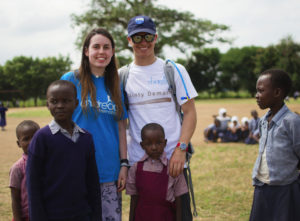
“We left the UK on the 13th of June, from Heathrow airport. After a long day of travelling we arrived in Moshi Town via Kilimanjaro International airport. The next day was a rest day where we explored Moshi Town and generally got ready for the climb, buying supplies, such as snacks. Day three of the trip was one of the most magical days of my life; we went to the school project that our money had helped build and maintain. We got to see the emphasis on small class sizes, and interestingly, the emphasis on personal hygiene, with large communal hand washing facilities. Hygiene in rural Africa is often a huge problem, as many people are not educated on the dangers of not washing your hands after the toilet or before you eat. The Childreach program aims to rectify this through education and making the process of washing hands fun for the children. The children put on a small assembly for us, with some traditional Tanzanian songs, including the national anthem. We then got a few hours to play with the children who ranged from the ages of 4-9. We played football and tig to name a few. The children loved every second of it, as did we. It can often be easy to criticise the effects of charity, and to be very cynical. This is all forgotten when you see the big smiles on the faces of these children when they are playing with you, and we all realised how far our money goes in such a disadvantaged region.
Then we got onto the climb. The climb starts at Machame gate which is at 1800m and is a 6 day trek in total.
The first section of the climb is to Machame camp and is through thick rain forest which took about 7 hours. Spirits were high here; it wasn’t too hard going.
Day 2 is to Shira camp, and for me other than the summit it was the most scenic part of the climb, through the last of the rain forest, until the vegetation becomes ‘heath.’
Day 3 was from Shira camp to lava tower, which is a huge build up of volcanic rock, and as a geographer it was very interesting to me. After a short stop at lava camp for lunch we carried on to Barranco camp, and this section of the hike we had the worst weather, with almost blizzard like conditions. This hike was known as acclimatization day, as we hike high to lava camp, but then Barranco camp is only as high as Shira camp on day 2. This is known as the ‘hike high sleep low’ method of hiking which is used for most peaks over 5000m.
Day 4 was the formidable challenge of Barranco wall, which is almost 400m vertical wall that you have to scramble up. This was one of the hardest days of climbing. When you get to Karanga Camp you are at 3,900m, and still get a mobile signal!
Day 5 was the last day before summit night. We walked from Karanga Camp to Barafu Camp (4,500m). When we arrived at Barafu camp, we had tea and slept until 11:30pm, where we pushed onto the summit.
Summit day was one of the hardest days of my life. 12 hours uphill, with the added bonus of altitude sickness, which made me throw up a few times on the way up! I got to stella point first, and in the Arctic conditions (-5) I was unsure if I even wanted to continue. But the guides helped push me along, and an hour later (only 200m took an hour!) I was stood at Uhuru point; the highest point on the African continent at 5895m.
Once we summited, we had the arduous task of coming back down, which in some respects is even harder, as it puts enormous stress on your knees and ankles, and by the time you get down on day 7 you are relieved, and never want to walk again!
Once we got back to Moshi town we rested and recuperated, and the next day, bright and early we went off on Safari!
We went in modified Toyota landcruisers, with fridges of beer (!!), plug sockets for charging phones and a convertible system, where we could stand out the top of the vehicle. We went to the Great Rift Valley and Lake Manyara, where we saw Elephants, Giraffes, Zebras and Baboons. After a night under the stars, with campfires and traditional tribal dancing at a local campsite we headed off to the Ngorongoro crater, where we saw the crown jewel of the African safari; Lions. We saw 2 females with 2 cubs each, and one solitary male. Here we also saw Hippos and a single Rhino. The only animal of the big 5 that we did not see unfortunately was the leopard.
After the safari was over we headed to the world renowned beach resorts of Zanzibar, which struck me as a very poor place, but with absolutely lovely people. We spent a few days relaxing on the beach, but unfortunately as it is the Southern Hemisphere winter the weather was mostly overcast and it rained. We did see some bright spells though, and the nightlife was fantastic.
Travelling home was a sobering experience. We transited through Istanbul Ankara airport at around 10am local time, and only 6 hours later, once we landed in Heathrow we got the news of the horrible terrorist attacks on the airport that we stood in.
A big thank you must be made for McGinty Demack for the amazing contribution, especially the t shirts and the flag, and I hope they have enjoyed working with me. I feel the partnership has really benefited the Childreach Projects in Tanzania, and hope we can work together in the future.
Lucas Martin